EU leaders visit India for Republic Day and 27 January summit, with trade, security and clean transition on agenda
European Council President António Costa and European Commission President Ursula von der Leyen are in New Delhi for India’s Republic Day celebrations and the 16th EU–India Summit on 27 January 2026. The EU says talks will focus on deepening the strategic partnership, including trade, security and defence cooperation, clean transition priorities and broader people-to-people links.
The European Union’s top leadership is in India this week for a high-profile visit that combines symbolism with substantive negotiations. European Council President António Costa and European Commission President Ursula von der Leyen travelled to New Delhi to represent the EU at the 16th EU–India Summit, scheduled for 27 January 2026.
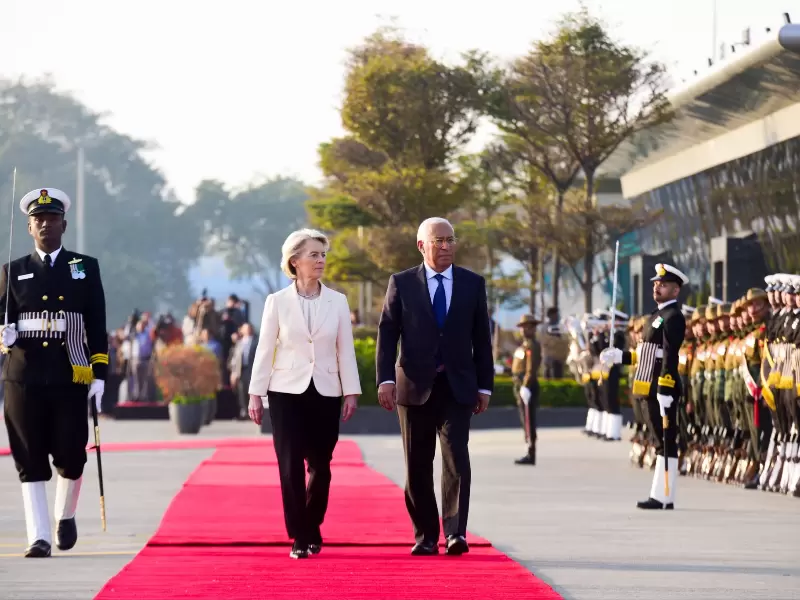
A day before the summit, the two leaders participated in India’s 77th Republic Day celebrations on 26 January as guests of honour. The EU described this as a first for the bloc’s leadership at Republic Day, framing the appearance as a marker of deeper ties between New Delhi and Brussels.
According to the EU, the summit discussions with Prime Minister Narendra Modi are expected to cover a wide policy slate, including trade and economic cooperation, security and defence collaboration, the clean transition, and enhanced cooperation between people and institutions. The EU has been positioning India as a central partner in its broader Indo-Pacific outlook and in efforts to strengthen a rules-based international order.
The visit’s schedule underlines its diplomatic weight, with the Republic Day appearance acting as a public signal and the summit as the working session. EU communications around the trip emphasise that both sides are looking to build on the existing strategic partnership and translate long-running conversations into clearer deliverables.
Beyond the India leg, the European Council said Costa is set to travel onwards to Vietnam on 29 January 2026 as part of a broader regional engagement, indicating that the India visit is being treated as part of a larger strategic sequence rather than a standalone stop.
With geopolitics, technology supply chains and energy transition pressures reshaping global alignments, the EU–India summit is being watched as a moment to test whether shared interests can be converted into faster progress on trade, security cooperation and standards-driven collaboration.